
Pan Merchant Aims To Quadruple Revenue in 2 - 3 Years - Executive Director
NewsRise | moomoo.com Online - 7 August 2026 View the original article
_________________________
Pan Merchant, a Malaysia-based solid-liquid filtration-system maker, is aiming to quadruple its revenue in the next two to three years as it expands beyond its core palm-oil market into mining and water treatment, its executive director said.
The company is seeking to raise its global market share to about 2%-to-3% from about 0.5% currently, Wong Nyeon Thiat told NewsRise in an interview. A 2% market share would imply annual revenue of about 600 million ringgit, Wong said, clarifying that the figure is an ambition, not a forecast.
"If I'm pushing my revenue numbers four times, my capacity must be able to meet (those) numbers," she said. "You can sell... but if you cannot produce, it is meaningless."
Overseas markets contributed about 25% of revenue during the first quarter of 2026 and Pan Merchant is targeting to raise such share to 40% as it expands its Europe and U.S. footprints and pursues mining opportunities in Australia, Indonesia and Kazakhstan. For the domestic market, it is pursuing industrial-mineral and non-radioactive rare-earth projects, where it already supplies filtration equipment to a pilot plant in the Perak state.
Pan Merchant's diversification push taps into two global mega-trends: mounting demand for water as data centers and AI infrastructure proliferate, and rising demand for critical-minerals with energy transition initiatives and electric vehicle production. Both offer Pan Merchant ways to diversify its cyclical reliance on edible oil industry.
Indonesia, which produces about 40% to 45% of the world's nickel supply, would be a focus after China pulled back from some local mineral-processing activity, Wong said.
"Now that I see this happening, I am going to go in, in a very aggressive way," she said. "My filters are proven and I have got plenty of installations of such sizes in Indonesia."
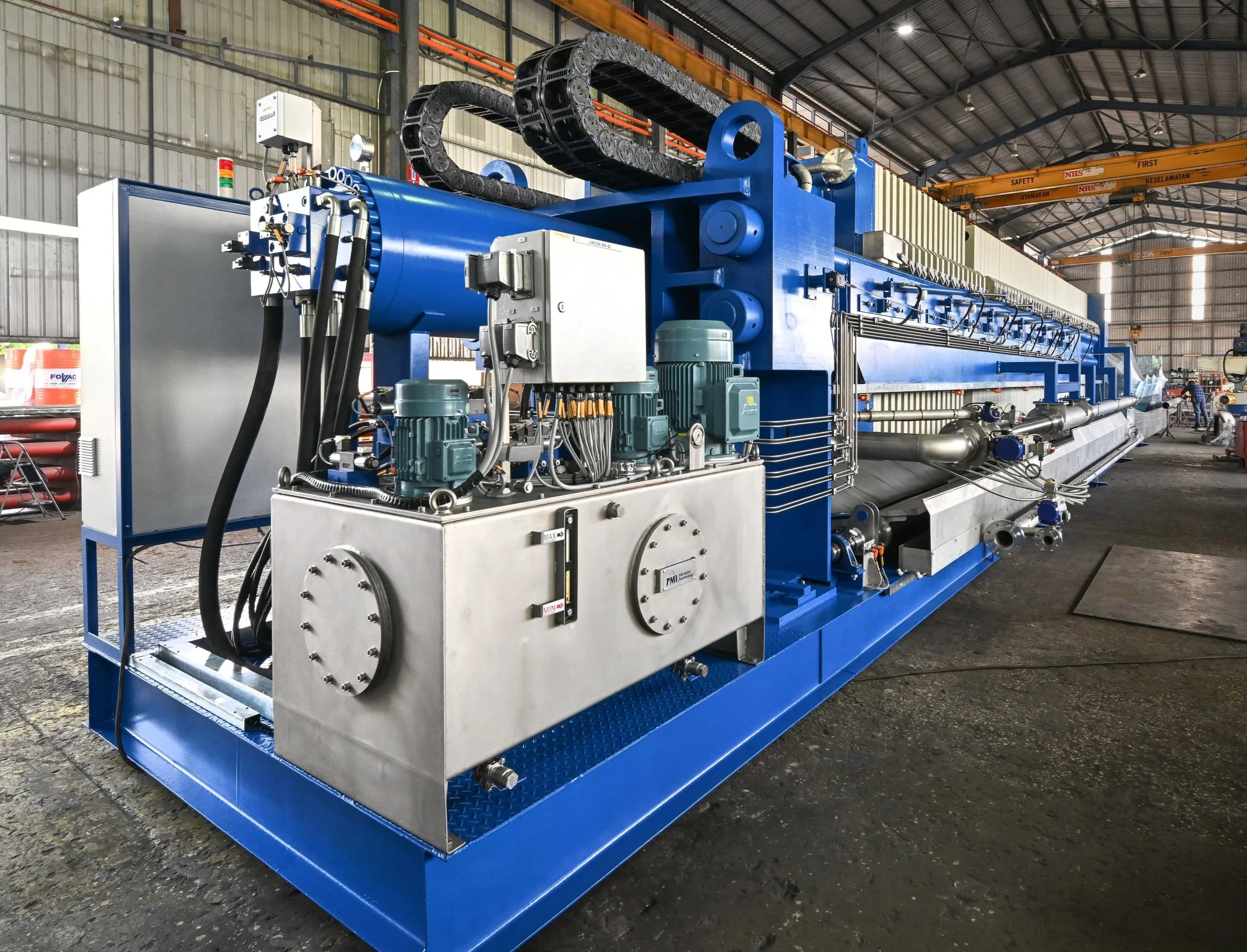
However, water treatment is the immediate new growth sector in Malaysia, Wong said. Pan Merchant's filter presses dewater sludge faster than traditional lagoons and reduces land use.
A reference project supplying to Singapore's National Water Agency (PUB) at Kota Tinggi water treatment plant helped establish the technology's credibility and contributed to Pan Merchant securing a 26.49-million-ringgit ($6.47 million) contract for the Sungai Rasau water supply scheme in Malaysia, a win Wong said has already prompted inquiries from other potential clients.
The company believes the market is beginning to recognize filter presses as an alternative to sludge lagoons, Wong said. "We are receiving more inquiries after (winning the) Sungai Rasau (project), although conversion takes time because utilities and contractors first need to understand the process (before) including it in their specifications."
Wong estimated Malaysian water-treatment opportunities could be worth hundreds of millions of ringgit, and the company is also assessing projects in Vietnam and Cambodia.
Still, palm oil remains the base business, with further growth expected in Africa and Central America, tracking expansion of plantation players in those regions, she said.
Pan Merchant also wants recurring revenue from the spare parts business to rise toward 40% of business, from 20% to 25% currently, as its installed base grows. "A larger installed base creates demand for replacement parts, upgrades and refurbishment," Wong said.
To meet those goals, the company allotted proceeds from its initial public offering to fund automation to cut labor dependency, waste and production time, allowing it to recognize revenue faster as projects advance.
Automation is essential if the company wants to scale without losing quality or margin, Wong said. As faster production increases capacity, the factory must still deliver at the right margin, she added.
The management expects meaningful progress within two-to-three years, given large equipment takes six-to-twelve months to build before installing.
"This is a gradual industrial business," Wong said. "Growth of 5%-to-15% in the established Asian business would already be positive, while newer markets add momentum."
A wider mix of industries and geographies should help reduce Pan Merchant's exposure to individual market cycles, she said. "Diversification gives us more areas to tap and helps mitigate risk."
Read the full report here.